Assimilation
The Canadian Land Data Assimilation System (CaLDAS) is the new land surface data assimilation system that is currently being developed and tested for operational implementation at the Meteorological Service of Canada. As shown in the figure below, CaLDAS ingests ancillary datasets, atmospheric forcings, and various types of observations to produce land surface analyses for numerical weather prediction systems (i.e., the Global Deterministic Prediction System, the Global Ensemble Prediction System, the Regional Deterministic Prediction System, the Regional Ensemble Prediction System, and the High-Resolution Deterministic Prediction System), for upper-air assimilation systems (4DVAR in the deterministic systems, Ensemble Kalman Filter for the ensemble systems). The land surface analyses produced by CaLDAS are also useful for other applications and government departments (e.g., agriculture, forests).
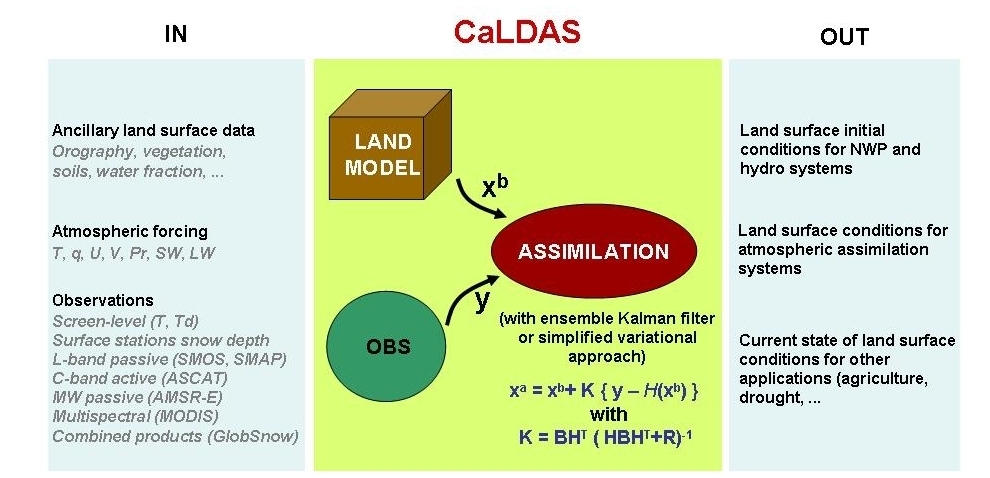
The land surface analyses produced by CaLDAS include the surface temperatures (skin and mean surface temperatures), soil moisture for superficial and root-zone reservoirs, and snow mass.
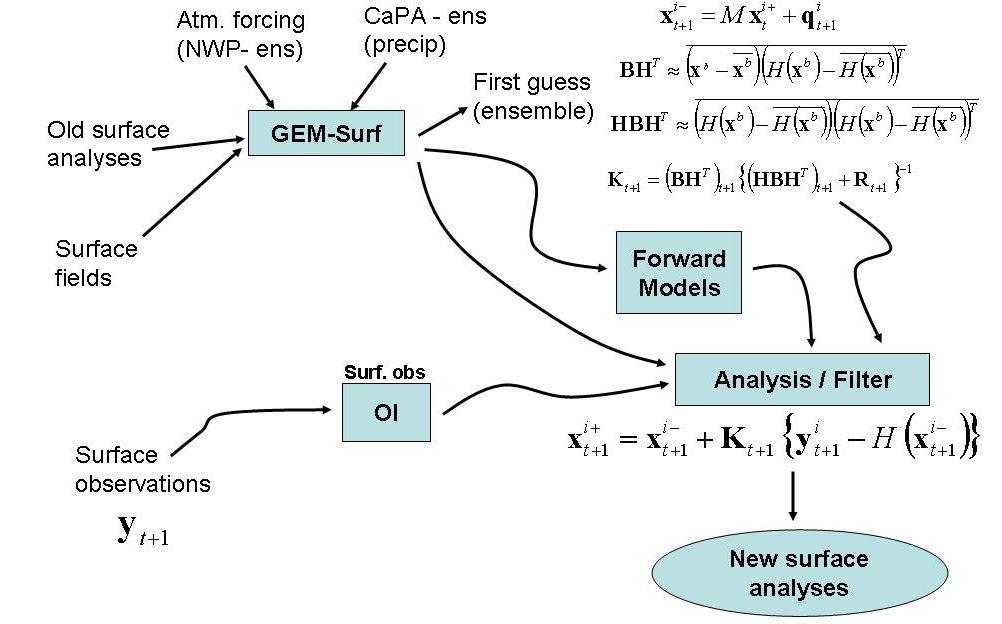
The ancillary data and atmospheric forcings are the same as what is used for the external land surface system GEM-Surf. In fact, GEM-Surf is used in CaLDAS to generate an ensemble of first guess runs from which statistics are extracted to evaluate the optimal weights between observations and first guess.
The observations currently assimilated in CaLDAS are:
- surface-based measurements of screen-level air temperature and dew point temperature;
- surface-based measurements of snow depth;
- space-based L-band passive measurements (i.e., L-band brightness temperatures) from the Soil Moisture and Ocean Salinity (SMOS) satellite (SMOS observations);
- retrievals of snow water equivalent from space-based microwave brightness temperatures from the Advanced Microwave Scanning Radiometer-Earth Observation System (AMSR-E)
- retrievals of snow water equivalent from GlobSnow (based on AMSR-E and / or on the space-based Special Sensor Microwave Imager, SSM/I).
Other types of observations are planned to be assimilated in CaLDAS, including the active and passive L-band microwave data from the Soil Moisture Active Passive (SMAP) mission, and vegetation retrievals from the Moderate Resolution Imaging Spectroradiometer (MODIS).
More details are provided in this next figure about the inner processes in CaLDAS.
References
More explanations and descriptions of CaLDAS are given in these scientific articles:
Carrera, M.L.: Submitted in 2014 to J. Hydromet.
Carrera, M.L.: To be submitted to J. Hydromet.
