
An overview of all these systems is presented in the figure below.
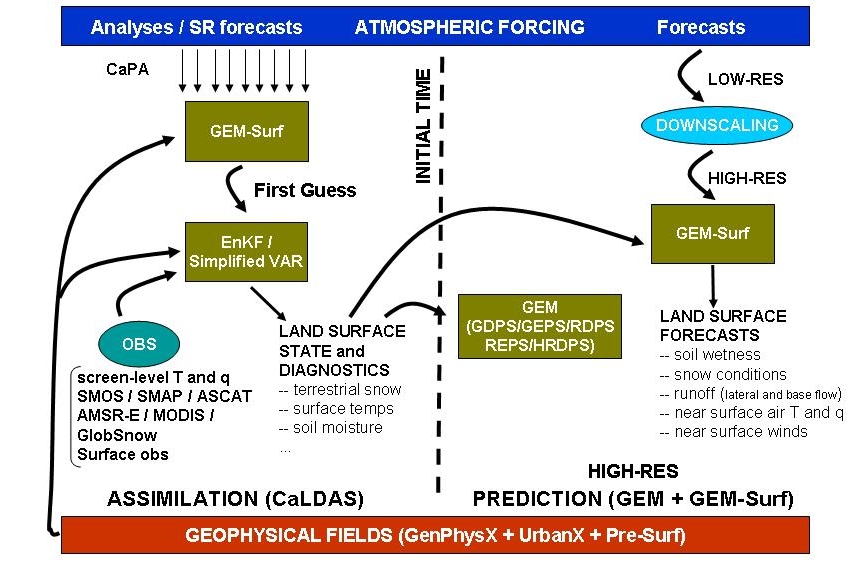
The line in the middle of the figure refers to the time of the analysis, i.e., t=0. Everything on the left of this line is in the "past" and actually describe the Canadian Land Data Assimilation System (CaLDAS). Everything on the right is in the "future", and inform on the atmospheric model (GEM) and on the external land surface prediction system (GEM-Surf).
The first guess in CaLDAS is provided by integrations from GEM-Surf, which is forced by MSC's most accurate estimates of atmospheric forcing. Either short-range forecasts or surface analyses are used for near-surface air temperature, humidity, and winds. Short-range forecasts are used for radiative forcing. The Canadian Precipitation Analysis (CaPA) is used for precipitation. Land surface conditions for GEM-Surf are provided using the Surface Processor including GenPhysX, UrbanX, and the Pre-Processor. Observations (from both surface and space) are provided to the analysis component of CaLDAS, either an Ensemble Kalman Filter or a simplified variational system, and combined in an optimal manner with GEM-Surf's first guess to produce the land surface analyses.The plan is to have the land surface initial conditions from CaLDAS used in the GEM atmospheric model (in the Global Deterministic Prediction System, the Global Ensemble Prediction System, the Regional Deterministic Prediction System, the Regional Ensemble Prediction System, and in the High-Resolution Deterministic Prediction System). The land surface initial conditions are also to be used in the GEM-Surf external land surface prediction system. GEM-Surf is typically integrated at the sub-kilometer scale in order to refine atmospheric predictions from GEM. GEM-Surf's atmospheric forcing are obtained from downscaled GEM forecasts, and high-resolution surface characteristics are directly produced on the GEM-Surf grid by the surface processor.